
Jackson’s Story: Early Action, Big Results in Plagiocephaly Care
When Jackson was born, his parents already knew what to look for. Their older son, Ethan, had also experienced plagiocephaly, so they were familiar with the early signs.
“Within Jackson’s first month, we noticed some flattening on the back of his head. At his two-month checkup, our pediatrician confirmed our concerns,” his mom recalls. “He mentioned that Jackson’s flattening was actually more pronounced than Ethan’s had been at the same age.”
Because of their past experience, Jackson’s family knew early intervention was essential—and they moved quickly to begin the evaluation process.
Learning from Their First Experience
Even though they weren’t new to the diagnosis, they carried lessons from their first journey through helmet therapy.
“With our oldest, we faced challenges like skin sores, fit issues, and unclear communication. We just wanted things to be smoother and more supportive this time.”
Determined to find a better experience for Jackson, the family explored new care options—and discovered OP Specialty Bracing (OPSB)’s brand-new Columbus, Ohio clinic.
“No parent wants to hear their baby needs a helmet, but we knew acting quickly would give Jackson the best outcome. The longer we waited, the harder it would be to correct.”
Choosing the Right Path Forward
Because Jackson’s condition appeared early, his parents understood that conservative measures like repositioning and tummy time might not be enough on their own. With guidance from their pediatrician, they decided to start helmet therapy early to take advantage of the rapid growth phase.
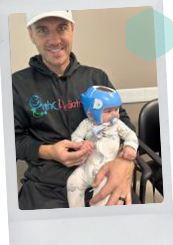
A Trusted Partnership in Care
From the first appointment, the family knew they’d made the right choice. “Our experience with OPSB has been so positive and professional. The team has been clear, supportive, and genuinely invested in Jackson’s progress,” his mom said.
Their trust in the team also came from a personal connection. “I’ve worked with Orthopediatrics, OPSB’s parent company, for five years. I already knew the organization’s mission and how much they care about children and families. Partnering with OPSB felt natural—it was working with people who truly put kids first.”
A Happy Ending (and a Happy Baby!)
Jackson began treatment with the OPSB Boston Band, and the results came quickly. “The adjustment phase went better than we expected—no major discomfort, no irritation, and Jackson was wearing the helmet for 23 hours a day by the second day,” his mom said. At his three-week checkup, the family got incredible news: Jackson’s head shape had already improved significantly. “It was so encouraging to see visible progress so soon. After our first experience, we were amazed by how well this process has gone.”
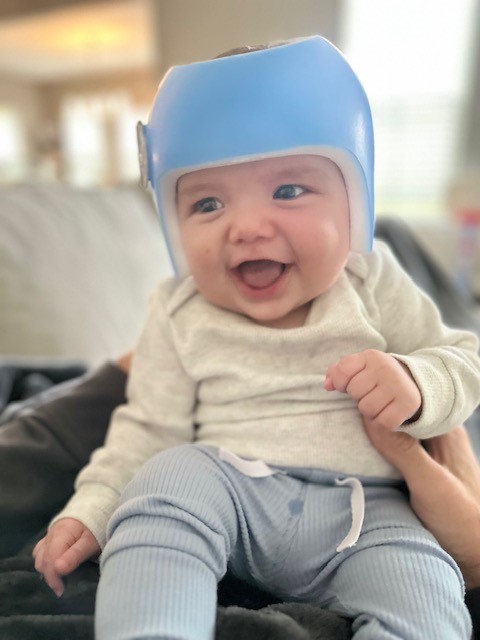
A Smooth Smart and Encouraging Results
While the family admits there are still daily tasks—like cleaning the helmet and checking for redness, those challenges feel minor compared to the long-term benefits. “The emotional side can be hard at first because no one wants their baby to need extra care,” they reflected. “But seeing Jackson adapt so quickly reminds us this is just a short phase for a lifetime of benefit.”
Advice From One Family to Another
“Plagiocephaly is common and highly treatable and there are amazing teams out there who will guide you through it. The helmet might seem like a big deal right now, but it’s such a short chapter in your child’s story, and it can make an incredible difference for their future.”
Disclaimer:
OPSB products and products distributed by OrthoPediatrics Corp. and its subsidiaries should be used under the guidance of a qualified healthcare professional. Individual results may vary. The Boston Band® is intended for medical purposes to passively hold prominent cranial regions of an infant’s skull in order to improve cranial proportion and symmetry in infants from three to eighteen months of age, with nonsynostotic positional plagiocephaly, including infants with plagiocephalic, brachycephalic and scaphocephalic patterned head shapes. The device is also indicated for adjunctive use for infants from three to eighteen months of age whose synostosis has been surgically corrected, but who still have moderate to severe cranial deformities including plagiocephalic-, brachycephalic-, and scaphocephalic-shaped heads. Please consult your pediatrician or orthopedic specialist for professional advice. This content is for informational purposes only and does not constitute medical advice. Always follow your doctor’s recommendations and instructions.
MAM-MM-086

